
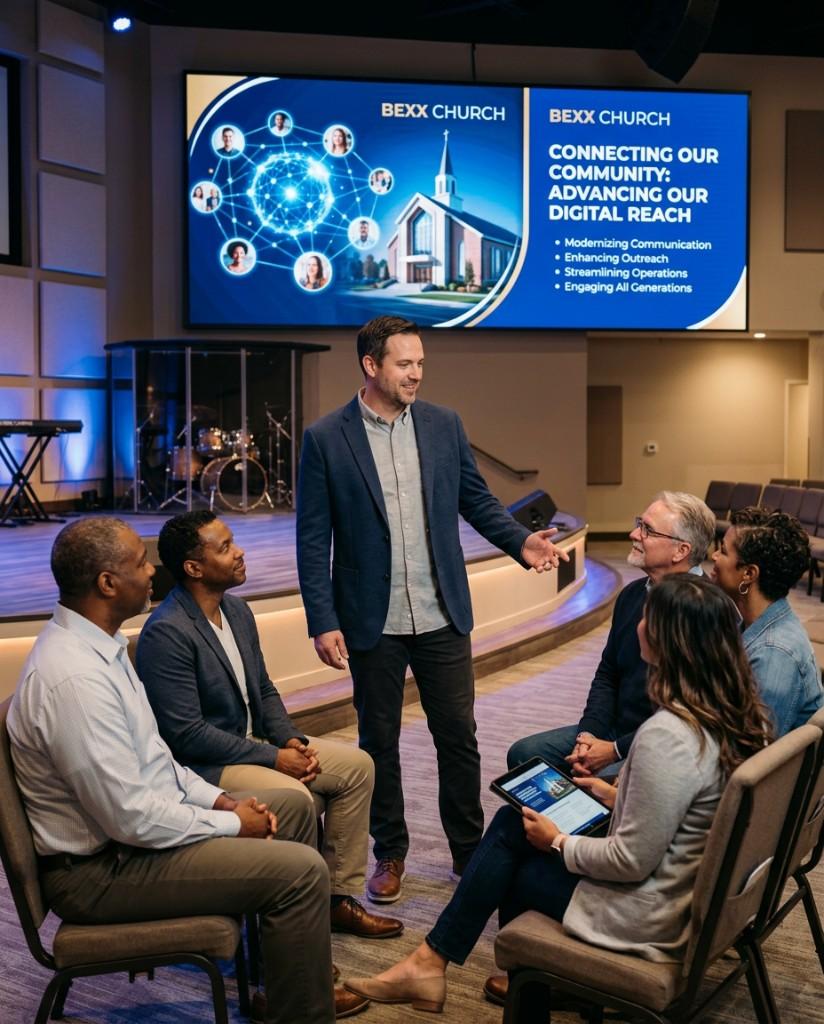
You know your church needs better technology. Maybe it is a new church management platform, online giving, a digital bulletin, or a church website. But before you can implement anything, you need your board or leadership team to say yes.
Here is how to present a technology proposal that gets approved.
Lead with ministry impact, not features
Board members do not care about API integrations, drag-and-drop editors, or cloud-based architecture. They care about ministry outcomes.
Instead of "this platform has automated email campaigns," say "this tool will help us follow up with every first-time visitor within 24 hours, something we currently miss about 60 percent of the time."
Instead of "it includes a giving dashboard," say "we will finally be able to see giving trends and identify families who may have stopped giving so we can reach out pastorally."
Translate every feature into a ministry benefit.
Show the cost of doing nothing
Many boards hesitate because they see technology as an expense. Help them see the cost of the current situation:
- How many hours per week does staff spend on tasks the new system would automate?
- How much does the church spend on printing bulletins, mailing statements, or running separate software subscriptions?
- How many visitors have we lost touch with because we did not follow up quickly enough?
- How much giving are we missing because we do not offer online or recurring options?
Quantify these whenever possible. "We spend $3,600 per year on printing and 5 hours per week on manual data entry" is more persuasive than "it would save us time and money."
Propose a pilot, not a permanent commitment
Boards are more likely to approve a trial than a permanent change. Propose a 60 or 90 day pilot with specific success metrics. For example: "Let us try the digital bulletin for 90 days. If we see at least 50 percent adoption and positive feedback from the congregation, we make it permanent."
This lowers the perceived risk and gives skeptics a way to say yes without feeling locked in.
Address security and privacy upfront
Board members, especially those with business backgrounds, will ask about data security. Be prepared to answer:
- Where is the data stored? (Look for answers like "encrypted cloud servers" or "SOC 2 compliant")
- Who has access to member information?
- What happens to our data if we stop using the platform?
- Is the giving system PCI compliant?
If you cannot answer these questions, research them before the meeting. Showing that you have thought about security builds confidence.
Present a case study
Nothing is more persuasive than a real example. Find one or two churches similar to yours that have adopted the technology you are proposing. If you can get a brief testimonial or share specific results (e.g., "First Baptist switched to digital bulletins and saw 68 percent weekly engagement"), it makes the proposal tangible.
Identify a champion on the board
Before the formal presentation, talk to one or two board members individually. Share your thinking, get their feedback, and address their concerns privately. If you can walk into the meeting with at least one board member already supportive, the conversation shifts from "convince the skeptics" to "discuss the details."
Set measurable goals
End your proposal with clear, measurable success criteria. "We will consider this successful if, within 90 days, we see: 50+ percent of the congregation using the digital bulletin, a 15 percent increase in online giving, and at least 3 hours per week of staff time saved."
Measurable goals give the board confidence that this is not a vague experiment. They also give you accountability, which builds trust for future technology proposals.
Start with free tools
If budget is a concern, start with platforms that offer full functionality for free. ChurchRaise, for example, provides people management, online giving, digital bulletins, event management, and AI assistants at no cost. When the board hears "we can try this with zero financial risk," the most common objection disappears.
The goal is not to overwhelm your board with technology. It is to help them see that the right tools can multiply your ministry's effectiveness while reducing the administrative burden on your team. For a complete overview of the tools available, see our guide to the modern church technology stack.